Showing posts with label GSA 2017. Show all posts
Showing posts with label GSA 2017. Show all posts
Friday, December 1, 2017

Monday, November 6, 2017
Thanks for a great GSA 2017
Hi Everyone,
The GSA Geobiology & Geomicrobiology Division Executive Committee would like to say a hearty "THANK YOU" for making this past GSA annual meeting in Seattle such a success. The number of GBGM talks skyrocketed this year and (as is often the case), it was standing room only for the awards luncheon.
Below are some photos of the awards lunch.

(Most of) the GBGM Executive Committee
This year's Post-Tenure Award Recipient: Susannah Porter (UC Santa Barbara)

This year's Pre-Tenure Award Recipient: Chris Reinhard (Georgia Tech)
The winners of the best student talk and poster presentations from the 2016 GSA annual meeting
And a few more shots of the room....


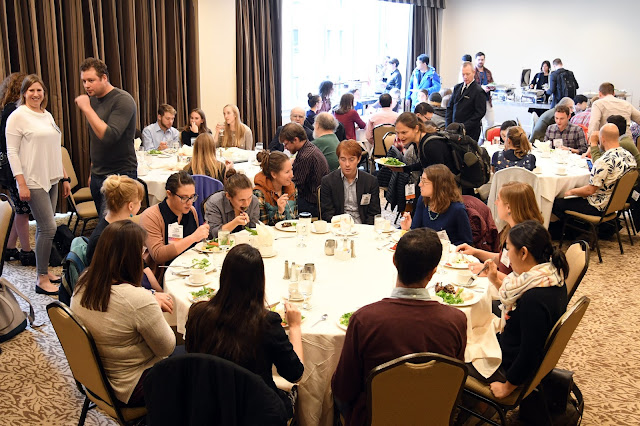
The GSA Geobiology & Geomicrobiology Division Executive Committee would like to say a hearty "THANK YOU" for making this past GSA annual meeting in Seattle such a success. The number of GBGM talks skyrocketed this year and (as is often the case), it was standing room only for the awards luncheon.
Below are some photos of the awards lunch.

(Most of) the GBGM Executive Committee
 |
| (L to R): Carie Frantz, Simon Darroch, Vicky Petryshyn, Lydia Tackett |
This year's Post-Tenure Award Recipient: Susannah Porter (UC Santa Barbara)

 |
| (L to R): Carie Frantz, Simon Darroch, Susannah Porter, Vicky Petryshyn, Lydia Tackett, Rowan Martindale |
 |
| (L to R): Carie Frantz, Simon Darroch, Susannah Porter, Vicky Petryshyn, Lydia Tackett, Rowan Martindale |
This year's Pre-Tenure Award Recipient: Chris Reinhard (Georgia Tech)
 |
| (L to R): Carie Frantz, Simon Darroch, Chris Reinhard, Vicky Petryshyn, Lydia Tackett, Rowan Martindale |
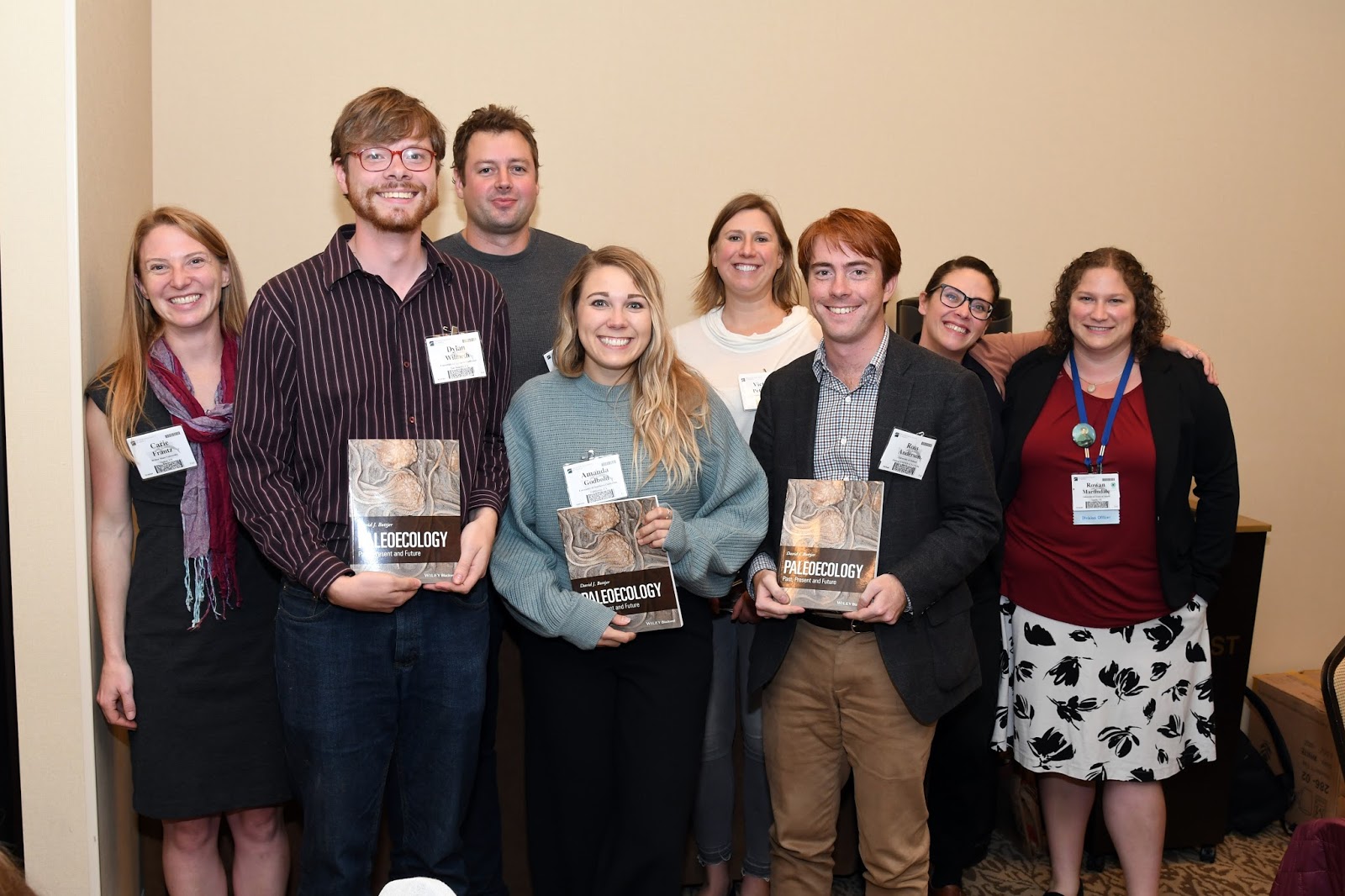 | ||||
| (Back row, L to R): Carie Frantz, Simon Darroch, Vicky Petryshyn, Lydia Tackett, Rowan Martindale. (Front row award winners, L to R): Dylan Wilmeth, Amanda Godbold, Ross Anderson (Natalia Bykova not present) |


SEE YOU NEXT YEAR!
Monday, October 23, 2017
GSA Geobiology & Geomicrobiology Lunch at GSA 2017
Today is the day! Come by for the GSA GBGM annual luncheon and division awards at GSA 2017 in Seattle. No reservations needed, lunch is free for all Geobiology enthusiasts!
Monday, 23 October 2017
12:00 PM - 01:15 PM
Sheraton Seattle Hotel - Issaquah
Monday, 23 October 2017
12:00 PM - 01:15 PM
Sheraton Seattle Hotel - Issaquah
Saturday, October 21, 2017
Welcome to Seattle!
Welcome to the 2017 GSA Meeting! We hope you have a great meeting, and you can start it off right with a full day of Geobiology!
New Voices in Geobiology (sessions 30 & 60)
Sunday, 22 October 2017: 8:00 AM-12:00 PM & 1:30 PM-5:30 PM
Room 602/603 (Washington State Convention Center)
https://gsa.confex.com/gsa/2017AM/webprogram/Session43064.html
https://gsa.confex.com/gsa/2017AM/webprogram/Session44161.html
New Voices in Geobiology (sessions 30 & 60)
Sunday, 22 October 2017: 8:00 AM-12:00 PM & 1:30 PM-5:30 PM
Room 602/603 (Washington State Convention Center)
https://gsa.confex.com/gsa/2017AM/webprogram/Session43064.html
https://gsa.confex.com/gsa/2017AM/webprogram/Session44161.html
Friday, July 21, 2017
New Voices in Geobiology Invited Speakers
We are happy to announce that we have confirmed our three speakers for our GSA topical session: “New Voices in Geobiology (T249)” (Seattle, WA, October 22-25, 2017).
See you in Seattle!
- Anne Dekas - Assistant Professor at Stanford
- Kimberly Lau - Postdoctoral Fellow at UC Riverside
- Chris Reinhard - Assistant Professor at Georgia Tech *Our 2017 GSA GBGM Pre-Tenure Award Recipient
See you in Seattle!
Thursday, July 13, 2017
New Voices in Geobiology
Dear colleagues,
We encourage you to submit an abstract for our topical session: “New Voices in Geobiology (T249)” to be held at the GSA Annual Meeting in Seattle, Washington, on October 22-25, 2017.
The goal of this session is to bring together new research (and new researchers) focusing on the interplay between geologic and biologic processes with a special emphasis on new field sites, novel materials/methods, and the development/refinement of proxies. We particularly encourage early career faculty, postdoctoral researchers, and graduate students to submit abstracts to this session. Overall we hope to bring together scientists specializing in geobiology, biology,(geo)microbiology, paleobiology/paleontology, inorganic and organic geochemisty, paleoecology, paleoclimatology, and sedimentology to generate new, interdisciplinary ideas and collaborations at the intersection of these fields.
The GSA abstract website is now open for submissions and the abstract deadline is midnight, August 1st.
Feel free to contact us if you have any further questions. Please forward this on to colleagues or students who may be interested in this session.
We hope to see you at GSA!
The GSA Geobiology & Geomicrobiology Division Executive Committee
Victoria A. Petryshyn (University of Southern California)
Marc Laflamme (University of Toronto Mississagua)
Lydia S. Tackett (North Dakota State University)
Rowan C. Martindale (University of Texas at Austin)
Simon A.F. Darroch (Vanderbilt University)
Carie M. Frantz (Weber State University)
GSA GBGM Sponsored Sessions at GSA 2017
Thinking of going to GSA but not sure what session to submit to? How about these sessions (all sponsored by the GSA Geobiology & Geomicrobiology Division). Submit an abstract now (Deadline is August 1st, 2017)
T5. Arsenic and Other Geogenic Contaminants in Groundwater Resources: Linking Water Quality, Food Security, and Treatment
Prosun Bhattacharya, Abhijit Mukherjee, Saugata Datta, Mohammad Alauddin, Karen Johannesson, Jochen Bundschuh, Arslan Ahmad
The fate, transport, and effects of arsenic and other metals in groundwater and other natural water systems from regional to local scales will be discussed. This encompasses occurrence, mobility, biogeochemical cycling, epidemiological, and sustainable mitigation.
The fate, transport, and effects of arsenic and other metals in groundwater and other natural water systems from regional to local scales will be discussed. This encompasses occurrence, mobility, biogeochemical cycling, epidemiological, and sustainable mitigation.
T9. Groundwater Flow in Coastal and Marine Settings: From the Intertidal Zone to the Deep Seafloor
Alicia Wilson, Evan Solomon
Huge volumes of groundwater lie beyond the boundaries of traditional watersheds. This session will explore groundwater flow and biogeochemical cycling seaward of the high tide line, including studies of submarine groundwater discharge and sub-seafloor flow.
Huge volumes of groundwater lie beyond the boundaries of traditional watersheds. This session will explore groundwater flow and biogeochemical cycling seaward of the high tide line, including studies of submarine groundwater discharge and sub-seafloor flow.
T10. Groundwater Influenced Ecosystems: Springs, Gaining Streams, and Terrestrial Ecosystems
Brad David Wolaver, Laura J. Crossey, Rebecca Matthews Frus, Steven P. Loheide II
Groundwater maintains aquatic and terrestrial ecosystems in varied climates and seasons globally. Multidisciplinary advances in field and modeling techniques are needed to improve how such systems are characterized, monitored, and scientific findings conveyed to decision makers.
Groundwater maintains aquatic and terrestrial ecosystems in varied climates and seasons globally. Multidisciplinary advances in field and modeling techniques are needed to improve how such systems are characterized, monitored, and scientific findings conveyed to decision makers.
T17. Polar and Alpine Changes
W. Berry Lyons
Polar and high alpine environments are undergoing rapid changes including cryosphere loss, with important geomorphological, hydrological, biogeochemical, and ecological consequences. This interdisciplinary session will explore these changes in both the Arctic and Antarctic.
Polar and high alpine environments are undergoing rapid changes including cryosphere loss, with important geomorphological, hydrological, biogeochemical, and ecological consequences. This interdisciplinary session will explore these changes in both the Arctic and Antarctic.
T19. Springs: Providing Insights on Critical Groundwater Quality and Quantity Issues
Brian Katz, Sue Swanson, James L. Berglund
This session will highlight research studies on springs that cover a range of topics, including water quality, geochemical and microbiological tracers for elucidating sources of anthropogenic impacts, water quantity, ecology, springs restoration, and climate change.
This session will highlight research studies on springs that cover a range of topics, including water quality, geochemical and microbiological tracers for elucidating sources of anthropogenic impacts, water quantity, ecology, springs restoration, and climate change.
T20. The Critical Zone As Heterogeneous Media: Implications for Physical, Chemical, and Biological Processes
Wendy M. Robertson, Nicole West, Zsuzsanna Balogh-Brunstad, Michael H. Young
We encourage contributions that characterize heterogeneities in the Critical Zone and their connections to hydrologic and biogeochemical processes at a range of spatial and temporal scales.
We encourage contributions that characterize heterogeneities in the Critical Zone and their connections to hydrologic and biogeochemical processes at a range of spatial and temporal scales.
T58. Oxygen and Ecosystems from the Proterozoic to the Paleozoic
Noah J. Planavsky, Devon B. Cole, Christopher T. Reinhard
This session will explore recent efforts to develop a more comprehensive understanding of coupled oxygen availability and environmental conditions with biotic evolution and ecosystem development from the Proterozoic to the early Paleozoic.
This session will explore recent efforts to develop a more comprehensive understanding of coupled oxygen availability and environmental conditions with biotic evolution and ecosystem development from the Proterozoic to the early Paleozoic.
T59. Studies in Paleobiology and Paleoecology: In Honor of Professor David J. Bottjer
Thomas J. Algeo, Pedro J. Marenco, Margaret L. Fraiser, Matthew E. Clapham
This session honors Professor David Bottjer on the occasion of his stepping down as Editor-in-Chief of Palaeogeography Palaeoclimatology Palaeoecology after 16 years. He is a paleobiologist and paleoecologist working on organism-sediment interactions, early metazoan life, and recovery from mass extinctions.
This session honors Professor David Bottjer on the occasion of his stepping down as Editor-in-Chief of Palaeogeography Palaeoclimatology Palaeoecology after 16 years. He is a paleobiologist and paleoecologist working on organism-sediment interactions, early metazoan life, and recovery from mass extinctions.
T60. The Onset of the Great Ordovician Biodiversity Event (GOBE): Testing Hypotheses with Diverse Data Sets
Rebecca L. Freeman, Alycia L. Stigall
We request contributions testing hypotheses concerning the Late Cambrian to Ordovician biotic and abiotic drivers of GOBE. Diverse data sets illuminate the timing, initiating conditions, stratigraphy, and paleontology of this significant event in Earth’s history.
We request contributions testing hypotheses concerning the Late Cambrian to Ordovician biotic and abiotic drivers of GOBE. Diverse data sets illuminate the timing, initiating conditions, stratigraphy, and paleontology of this significant event in Earth’s history.
T66. Exceptionally Preserved Proterozoic–Early Paleozoic Fossils
Ross P. Anderson, Lidya G. Tarhan, Sean McMahon
Exceptionally preserved soft-tissue fossils are essential to the reconstruction of the emergence and diversification of early complex life. Here we consider new geologically and experimentally derived insights into the taphonomy of Proterozoic–early Paleozoic Lagerstätten.
Exceptionally preserved soft-tissue fossils are essential to the reconstruction of the emergence and diversification of early complex life. Here we consider new geologically and experimentally derived insights into the taphonomy of Proterozoic–early Paleozoic Lagerstätten.
T67. Fossils and Fossilization in Amber
Victoria E. McCoy, Sarah E. Gabbott
This session will explore all the diverse areas of amber paleontology, from the description of exceptional specimens, to the investigation of amber taphonomy, to innovative approaches to image or chemically characterized fossils in amber.
This session will explore all the diverse areas of amber paleontology, from the description of exceptional specimens, to the investigation of amber taphonomy, to innovative approaches to image or chemically characterized fossils in amber.
T68. Proxy Approaches to Determine Forest Structure in Deep Time: What Have We Learned?
Richard S. Barclay, Regan E. Dunn, Heather V. Graham
We will gather a diverse set of scientists who apply cross-disciplinary approaches to fossil plants and animals, stable isotopes, biogeochemistry, and the sedimentary record to assess the structure and density of forests in deep-time.
We will gather a diverse set of scientists who apply cross-disciplinary approaches to fossil plants and animals, stable isotopes, biogeochemistry, and the sedimentary record to assess the structure and density of forests in deep-time.
T69. The Role of Silica in the Earth System: From Organisms to Global Biogeochemical Cycles
Jonathan P. Wilson, Caroline A.E. Strömberg, Patrick J. Frings
This session seeks to bring together geochemists, modelers, soil scientists, physiologists, and paleontologists to discuss state-of-the-art knowledge of the terrestrial and oceanic silica cycles, links between them, and connections with other biogeochemical cycles through time.
This session seeks to bring together geochemists, modelers, soil scientists, physiologists, and paleontologists to discuss state-of-the-art knowledge of the terrestrial and oceanic silica cycles, links between them, and connections with other biogeochemical cycles through time.
T70. Paleogenomics and Geobiology
Jeffrey R. Thompson, David J. Bottjer
This session will include, though is not limited to, presentations utilizing approaches to interpret the fossil record and evolutionary trends through integration of data from the rock record with molecular biology, genomics, and developmental biology.
This session will include, though is not limited to, presentations utilizing approaches to interpret the fossil record and evolutionary trends through integration of data from the rock record with molecular biology, genomics, and developmental biology.
T94. Limnogeology—Progress, Challenges, and Opportunities on Earth and Beyond: A Tribute to Beth Gierlowski-Kordesch
David B. Finkelstein, Lisa E. Park Boush
This session explores new insights, critical thinking, and integrated analytical approaches, including sedimentology and stratigraphy, remote sensing, geophysical techniques, geomicrobiology, and geochemical studies applied to the interpretation of modern and ancient lake environments and sediments.
This session explores new insights, critical thinking, and integrated analytical approaches, including sedimentology and stratigraphy, remote sensing, geophysical techniques, geomicrobiology, and geochemical studies applied to the interpretation of modern and ancient lake environments and sediments.
T143. Curating Physical Samples in a Digital World
Leslie Hsu, Megan Carter, Anders J. Noren, Lesley A.I. Wyborn
Physical samples, such as cores, fossils, and water, have unique challenges for data stewardship because they are difficult, if not impossible, to fully digitize. We will explore challenges and solutions for digitally curating physical samples.
Physical samples, such as cores, fossils, and water, have unique challenges for data stewardship because they are difficult, if not impossible, to fully digitize. We will explore challenges and solutions for digitally curating physical samples.
T170. Rock Transforming to Soil—The Weathering Engine Intersects with the Carbon Cycle
Zsuzsanna Balogh-Brunstad, Marjorie Schulz
Geology and biology interact in hotspots of geochemical activity along the root rhizosphere. these reactions control soil development, nutrient availability, erosion, carbon cycling, etc. We welcome submissions from all scales, laboratory, field, and modeling studies.
Geology and biology interact in hotspots of geochemical activity along the root rhizosphere. these reactions control soil development, nutrient availability, erosion, carbon cycling, etc. We welcome submissions from all scales, laboratory, field, and modeling studies.
T248. Microbialite Textures and Chemical Signatures in Continental Settings: Forging the Link between the Modern and Ancient
Thomas A. Hickson, Julie K. Bartley
We seek abstracts that focus on the textures (macro- and microscopic) and geochemical signatures of microbial activity in continental settings. These abstracts should clearly forge a strong link between ancient rock sequences and modern biogeochemical processes.
We seek abstracts that focus on the textures (macro- and microscopic) and geochemical signatures of microbial activity in continental settings. These abstracts should clearly forge a strong link between ancient rock sequences and modern biogeochemical processes.
T249. New Voices in Geobiology
Victoria A. Petryshyn, Marc Laflamme, Lydia S. Tackett, Rowan C. Martindale, Simon A.F. Darroch, Carie M. Frantz
The goal of this session is to bring together new research focusing on the interplay between geologic and biologic processes with a special emphasis on new field sites, novel materials/methods, and the development/refinement of proxies.
The goal of this session is to bring together new research focusing on the interplay between geologic and biologic processes with a special emphasis on new field sites, novel materials/methods, and the development/refinement of proxies.
T250. Perspectives on The Deep Biosphere: Twenty-Five Years of Geobiology
John R. Spear, Blake W. Stamps
A critical yet little understood compartment of Earth is the life that lies beneath, the deep biosphere. Rich in geological, geochemical, and biological complexity, the subsurface continually supplies ecosystem services that maintains life on the surface.
A critical yet little understood compartment of Earth is the life that lies beneath, the deep biosphere. Rich in geological, geochemical, and biological complexity, the subsurface continually supplies ecosystem services that maintains life on the surface.
T254. The Co-Evolution of Life and Its Environment during the Precambrian: The “Boring Billion” and Mid-Proterozoic Emergence of Complex Life
Roger Buick, Matthew Koehler, Charles Diamond
This session explores the middle chapter of Earth’s history, which was characterized by an apparently prolonged period of biogeochemical stasis. Contributions that consider Proterozoic redox conditions, early eukaryotic evolution, long-term climatic regulation, and biogeochemical cycling are encouraged.
This session explores the middle chapter of Earth’s history, which was characterized by an apparently prolonged period of biogeochemical stasis. Contributions that consider Proterozoic redox conditions, early eukaryotic evolution, long-term climatic regulation, and biogeochemical cycling are encouraged.
T255. The Co-Evolution of Life and Its Environment during the Precambrian: The Late Proterozoic Rise of Animals; Climate, Tectonic, and Environmental Dynamics, and the Transition into the Early Paleozoic
Michael Kipp, J. Alex Zumberge, Timothy W. Lyons
This session explores the dynamic transitions of the Neoproterozoic, and particularly welcomes contributions that assess marine redox heterogeneity, cause-effect relationships between tectonic, climatic and biological evolution, and the chronology of these critical events.
This session explores the dynamic transitions of the Neoproterozoic, and particularly welcomes contributions that assess marine redox heterogeneity, cause-effect relationships between tectonic, climatic and biological evolution, and the chronology of these critical events.
T256. The Co-Evolution of Life and Its Environment during the Precambrian: The Rise of Oxygenic Photosynthesis and the Great Oxidation Event
Joshua Krissansen-Totton, Stephanie Olson, David C Catling
This session explores the Archean and the Paleoproterozoic, with a particular focus on the Great Oxidation Event, the antiquity of oxygenic photosynthesis, models of Earth’s biogeochemical cycles, and novel constraints on environmental conditions.
This session explores the Archean and the Paleoproterozoic, with a particular focus on the Great Oxidation Event, the antiquity of oxygenic photosynthesis, models of Earth’s biogeochemical cycles, and novel constraints on environmental conditions.
Tuesday, July 11, 2017
PaleoSoc student ambassador program
The Paleontological Society seeks to support undergraduate students interested in a career in paleontology who plan to attend the 2017 Geological Society of America meeting in Seattle, Washington (Oct 22-25, 2017).
A limited number of grants are available to offset travel costs: $1,000 if the undergraduate is presenting original research at GSA and $500 if the undergraduate is just attending the meeting. In addition to travel support, students will participate in mentoring opportunities with professional paleontologists and graduate students while at the meeting and receive a free 1‐year student membership to the Paleontological Society
In exchange, PS‐SAP students will be expected to volunteer at the PS booth for at least 5 hours during the meeting, and to use social media (e.g., blogs, Facebook, Twitter) to communicate to the Society about their experience at the meeting. In this way, students will serve as “ambassadors” for the Society.
To be eligible, students must be enrolled as an undergraduate student at an institution of higher education and have a stated interest in learning more about careers in paleontology.
All documents must be received by Thursday, July 20, 2017.
For more info, please see: http://paleosoc.org/students/paleontological-society-student-ambassador-program/
A limited number of grants are available to offset travel costs: $1,000 if the undergraduate is presenting original research at GSA and $500 if the undergraduate is just attending the meeting. In addition to travel support, students will participate in mentoring opportunities with professional paleontologists and graduate students while at the meeting and receive a free 1‐year student membership to the Paleontological Society
In exchange, PS‐SAP students will be expected to volunteer at the PS booth for at least 5 hours during the meeting, and to use social media (e.g., blogs, Facebook, Twitter) to communicate to the Society about their experience at the meeting. In this way, students will serve as “ambassadors” for the Society.
To be eligible, students must be enrolled as an undergraduate student at an institution of higher education and have a stated interest in learning more about careers in paleontology.
All documents must be received by Thursday, July 20, 2017.
For more info, please see: http://paleosoc.org/students/paleontological-society-student-ambassador-program/
Subscribe to:
Posts (Atom)