Showing posts with label 2017. Show all posts

Monday, November 6, 2017

Thanks for a great GSA 2017

Hi Everyone,

The GSA Geobiology & Geomicrobiology Division Executive Committee would like to say a hearty "THANK YOU" for making this past GSA annual meeting in Seattle such a success. The number of GBGM talks skyrocketed this year and (as is often the case), it was standing room only for the awards luncheon.

Below are some photos of the awards lunch.


(Most of) the GBGM Executive Committee
(L to R): Carie Frantz, Simon Darroch, Vicky Petryshyn, Lydia Tackett

This year's Post-Tenure Award Recipient: Susannah Porter (UC Santa Barbara)

(L to R): Carie Frantz, Simon Darroch, Susannah Porter, Vicky Petryshyn, Lydia Tackett, Rowan Martindale

This year's Pre-Tenure Award Recipient: Chris Reinhard (Georgia Tech)
(L to R): Carie Frantz, Simon Darroch, Chris Reinhard, Vicky Petryshyn, Lydia Tackett, Rowan Martindale
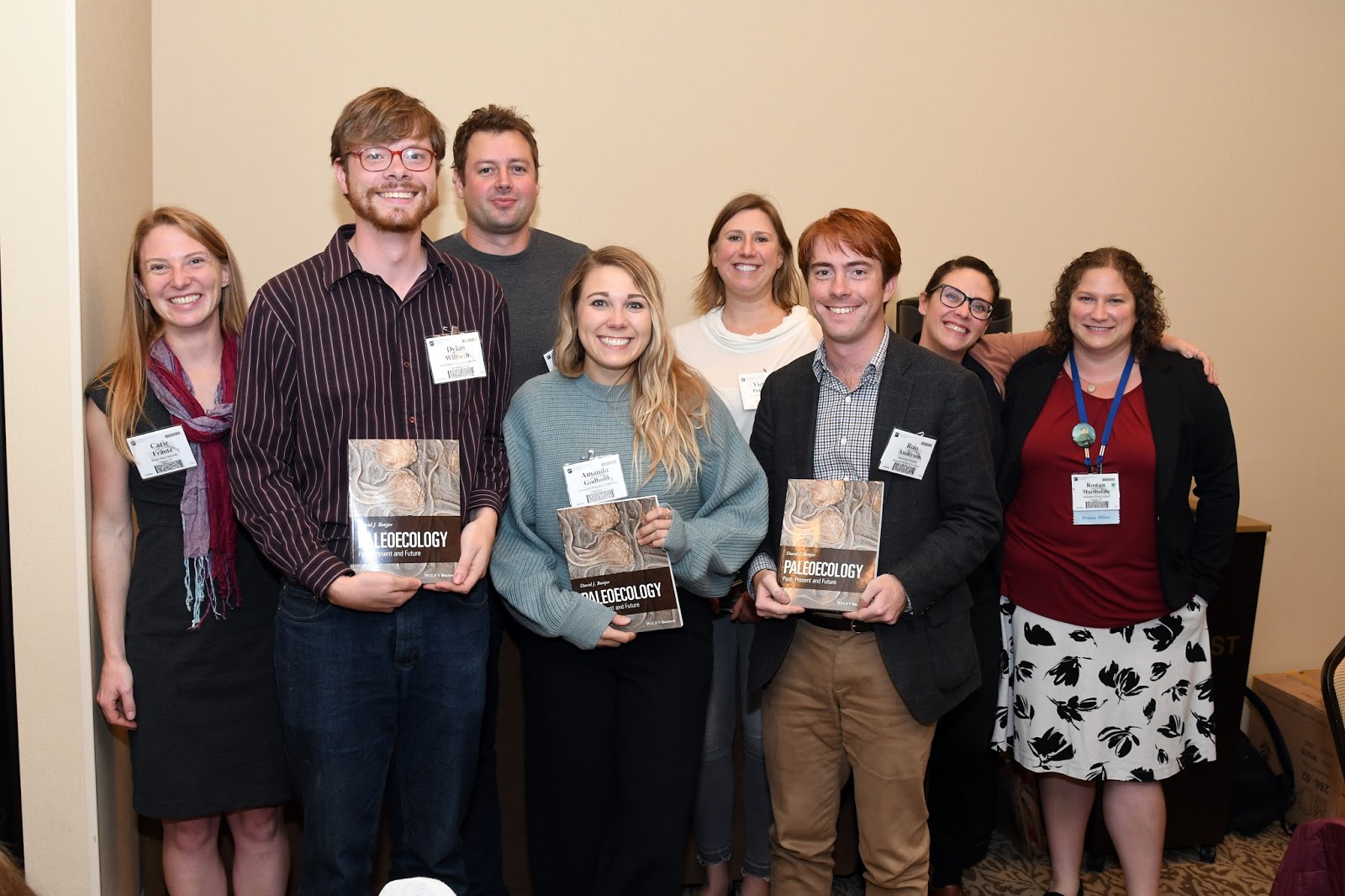
 The winners of the best student talk and poster presentations from the 2016 GSA annual meeting
(Back row, L to R): Carie Frantz, Simon Darroch, Vicky Petryshyn, Lydia Tackett, Rowan Martindale. (Front row award winners, L to R): Dylan Wilmeth, Amanda Godbold, Ross Anderson (Natalia Bykova not present)
    
 And a few more shots of the room....


SEE YOU NEXT YEAR!

Monday, October 23, 2017

GSA Geobiology & Geomicrobiology Lunch at GSA 2017

Today is the day! Come by for the GSA GBGM annual luncheon and division awards at GSA 2017 in Seattle. No reservations needed, lunch is free for all Geobiology enthusiasts!

Monday, 23 October 2017
12:00 PM - 01:15 PM
Sheraton Seattle Hotel - Issaquah

Saturday, October 21, 2017

Welcome to Seattle!

Welcome to the 2017 GSA Meeting! We hope you have a great meeting, and you can start it off right with a full day of Geobiology!

New Voices in Geobiology (sessions 30 & 60)
Sunday, 22 October 2017: 8:00 AM-12:00 PM & 1:30 PM-5:30 PM
Room 602/603 (Washington State Convention Center)

https://gsa.confex.com/gsa/2017AM/webprogram/Session43064.html
https://gsa.confex.com/gsa/2017AM/webprogram/Session44161.html

Monday, October 9, 2017

4 year fellowship Indiana University

Two four-year fellowships with generous salary and startup are available at Indiana University.  The positions come with research faculty status and are part of a network of 16 faculty and 12 fellow hires in the Prepared for Environmental Change grand challenges initiative.  While these are not exclusively paleo positions, candidates with interest in paleontological applications are welcome to apply.


ERI Fellow, Assistant Research Scientist, Species Distribution Modeling

The Environmental Resilience Institute (ERI) at Indiana University (IU) invites applications for a Fellow position in species distribution modeling to begin in Fall 2018; the appointment is renewable for up to four years. Applicants with interests in future distributions of migratory species and in integrating functional trait ecology with distribution models are especially encouraged to apply. Potential for using IU's state-of-the-art computational resources will be considered assets. Fellows will enjoy a generous research allowance, a rich collaborative environment, and eligibility to serve as PI on external grants.

The position is part of IU's Prepared for Environmental Change Grand Challenge initiative (http://grandchallenges.iu.edu/p4ec ). With a primary appointment in the ERI, the successful candidate will join a cohort of twelve Fellows of the ERI and a growing community of colleagues across the sciences, social sciences, and humanities who are engaged in this collaborative program of research and communication about environmental change. Formal affiliation with relevant department(s) and school(s) will be arranged on a case-by-case basis. Excellent fellow candidates will have experience with and openness toward multi-and trans-disciplinary collaborative research.  Applicants must have a Ph.D. prior to employment along with demonstrated research experience in species distribution models; applicants with prior post-doctoral training will be favored in the review process. Fellows will be expected to develop independent research programs that interface with ERI's multidisciplinary initiative.

Appointment will be for two years initially, with opportunity for renewal for an additional two years. While the position is not permanent, Fellows are encouraged to extend the appointment period through external funding.  Questions about the position should be directed to: David Polly, Search Committee Chair (pdpolly@indiana.edu).  Applications should be submitted by December 1, 2017 to ensure full consideration, but will continue to be considered until the position is filled.  Applications should be submitted online at https://indiana.peopleadmin.com/postings/4590

ERI Fellow, Assistant Research Scientist, Stable Isotope Migration Ecology.

The Environmental Resilience Institute (ERI) at Indiana University (IU) invites applications for a Fellow position in stable isotope ecology of migratory animals to begin in Fall 2018; the appointment is renewable for up to four years. Applicants with interest in reconstructing seasonal migration patterns and inferring dietary patterns are especially encouraged to apply. Expertise in establishing and using new stable isotope facilities, including hydrogen equilibration, will be considered assets. Fellows will enjoy a generous research allowance, a rich collaborative environment, and eligibility to serve as PI on external grants.
The position is part of IU's Prepared for Environmental Change Grand Challenge initiative (http://grandchallenges.iu.edu/p4ec ). With a primary appointment in the ERI, the successful candidate will join a cohort of twelve Fellows of the ERI and a growing community of colleagues across the sciences, social sciences, and humanities who are engaged in this collaborative program of research and communication about environmental change. Formal affiliation with relevant department(s) and school(s) will be arranged on a case-by-case basis. Excellent fellow candidates will have experience with and openness toward multi-and trans-disciplinary collaborative research.  Applicants must have a Ph.D. prior to employment along with demonstrated research experience in species distribution models; applicants with prior post-doctoral training will be favored in the review process. Fellows will be expected to develop independent research programs that interface with ERI's multidisciplinary initiative.

Appointment will be for two years initially, with opportunity for renewal for an additional two years. While the position is not permanent, Fellows are encouraged to extend the appointment period through external funding.  Questions about the position should be directed to: David Polly, Search Committee Chair (pdpolly@indiana.edu).  Applications should be submitted by December 1, 2017 to ensure full consideration, but will continue to be considered until the position is filled.  Applications should be submitted online at https://indiana.peopleadmin.com/postings/4591

Tuesday, July 11, 2017

PaleoSoc student ambassador program

The Paleontological Society seeks to support undergraduate students interested in a career in paleontology who plan to attend the 2017 Geological Society of America meeting in Seattle, Washington (Oct 22-25, 2017).

A limited number of grants are available to offset travel costs: $1,000 if the undergraduate is presenting original research at GSA and $500 if the undergraduate is just attending the meeting. In addition to travel support, students will participate in mentoring opportunities with professional paleontologists and graduate students while at the meeting and receive a free 1‐year student membership to the Paleontological Society

In exchange, PS‐SAP students will be expected to volunteer at the PS booth for at least 5 hours during the meeting, and to use social media (e.g., blogs, Facebook, Twitter) to communicate to the Society about their experience at the meeting. In this way, students will serve as “ambassadors” for the Society.

To be eligible, students must be enrolled as an undergraduate student at an institution of higher education and have a stated interest in learning more about careers in paleontology.

All documents must be received by Thursday, July 20, 2017.

For more info, please see: http://paleosoc.org/students/paleontological-society-student-ambassador-program/

Monday, June 12, 2017

Friday, May 26, 2017

2017 Division Awards for outstanding research


Every year the GSA Geobiology and Geomicrobiology division selects three exceptional researchers to receive pre-tenure, post-tenure, and distinguished career awards. This year we had an exceptional list of nominees and we are pleased to announce that the 2017 awards go to Chris Reinhard, Susannah Porter, and Marilyn Fogel. Please checkout their brief biographies below.

Pre-Tenure Award Recipient: Chris Reinhard (Georgia Tech)

 
Chris studied ecology and evolutionary biology as an undergraduate at the University of Kansas and pursued graduate research in Earth Sciences at the University of California, Riverside. He is currently Assistant Professor at Georgia Institute of Technology, with research interests that revolve around characterizing the chemical evolution of Earth's ocean-atmosphere system, how this evolution has been shaped by major biotic and ecological innovations, and the ways in which this history can be used as a proxy for characterizing remotely detectable biosignatures.


Post-Tenure Award Recipient: Susannah Porter (UC Santa Barbara)


Susannah received her bachelor's degree in Mathematics from Yale University in 1995 and her Ph.D. in Biology at Harvard University in 2002. After completing a one-year NASA Astrobiology Post-Doctoral Fellowship at UCLA, she moved to the University of California at Santa Barbara, where she is Associate Professor and Vice Chair in the Department of Earth Science. She studies the early fossil record of animals and their protistan relatives and has worked on problems relating to the evolution of skeletal biomineralization, the influence of snowball Earth glaciations on the biosphere, the early evolution of eukaryotes, and the Cambrian diversification of animals. She lives in Carpinteria, California, with her husband, Jamie, and her two sons, Willie and Sam.


Distinguished Career Award Recipient: Marilyn Fogel (UC Riverside)


Marilyn received her B.S. degree in Biology form Pennsylvania State University and her Ph.D. in Botany (Marine Sciences) from the University of Texas at Austin. She spent the majority of her career as a Staff Member at the Carnegie Institution of Washington’s Geophysical Laboratory (1977-2012). In 2013, Marilyn started her career as a Professor at the University of California, first in Merced, and  currently the Wilbur W. Mayhew Endowed Professor of Geoecology at the University of California, Riverside as well as the Director of the EDGE Institute. Marilyn's research concentrates on understanding the flow of elements through modern biogeochemical cycles using stable isotope compositions of organic and inorganic matter as tracers. She uses this knowledge of elemental cycling in modern ecosystems, to understanding how biogeochemical cycles functioned over Earth's history. Her work extends to the fields of paleontology and astrobiology.

Please join us in congratulating these three exceptional scientists at the GSA Geobiology Division Award Presentation during the 2017 GSA in Seattle.

Tuesday, April 18, 2017

2017 International Workshop on Konservat-Lagerstätten; July 15-16, 2017 in Cork (Ireland)

Join us at the 2017 International Workshop on Konservat-Lagerstatten from July 15-16 2017 in Cork (Ireland). This workshop will explore frontier research on fossil deposits preserving soft tissues of animals and plants and includes an exciting line-up of invited speakers. We welcome contributions on any aspect of the palaeobiology, taphonomy, and sedimentological context of Konservat-Lagerstatten. For more information see http://lagerstaetten.ucc.ie/. 
 
Abstract submission closes on 31st May 2017.
For More information contact: Dr Maria McNamara

Thursday, January 19, 2017

Propose Geobio Sessions for the 2017 GSA meeting

Help us promote Geobiology at the 2017 GSA in Seattle! Submit a relevant session proposal or short course that we can sponsor! Details below.

Submit a
Session Proposal
Call for Topical and Pardee Keynote Session proposals: 
The deadline is less than two weeks away: Wednesday, 1 February.
 
It’s time to plan for our 2017 Annual Meeting in Seattle, Washington. GSA is excited to head back to the Pacific Northwest. Our 2009 meeting in Portland, Oregon, attracted nearly 6,500 attendees from over 50 countries, so our 2017 meeting should be international, well attended, and full of excitement! A highlight will be the Seattle-area geology: glaciation, deposition, tectonics, crustal deformation, unconformities, erosion, bedrock structures, and drumlins. We challenge you to propose a technical session and/or a short course that will teach your colleagues and promote discussion about the incredible regional geology. Visit our Technical Session Proposals website for more information, and to submit your Topical or Pardee Keynote Session Proposal.

For additional information:
Dick Berg, GSA2017 Technical Program Chair
Kevin Mickus, GSA2017 Technical Program Vice Chair

Submit a Short Course Proposal
Call for Short Course proposals: 
The deadline is less than two weeks away: Wednesday, 1 February.
 
Have something that your peers need to know? Courses can be run to develop professional, teaching, and research skills at all levels. Please review the Proposal Guidelines or contact Jennifer Nocerino.

Tuesday, January 3, 2017