This is a website for the Geobiology and Geomicrobiology Division of GSA
Wednesday, June 12, 2024
2024 Division Awards for Outstanding Geobiologists
Monday, June 13, 2022
2022 Division Awards for Outstanding Geobiologists
Every year the GBGM executive committee selects exceptional scholars to receive awards for their accomplishments in research, education/mentoring, and service in geobiology. This year we had an exceptional list of nominees so thanks to all those who nominated someone!
We are pleased to announce that the 2022 awards go to Lidya Tarhan (pre-tenure), Cara Santelli (post-tenure), and John Valley (distinguished career). Please check out their brief biographies below and explore their websites for further details about their research.
Pre-Tenure Award Recipient: Lidya Tarhan (Yale University)
Post-Tenure Award Recipient: Cara Santelli (University of Minnesota)
Distinguished Career Award Recipient: John Valley (University of Wisconsin-Madison)
Tuesday, January 25, 2022
Nominate your colleagues for the 2022 GSA GBGM Awards!
Dear Geo(micro)biologists,
Every year the GSA Geobiology and Geomicrobiology division selects three exceptional researchers to receive pre-tenure, post-tenure, and distinguished career awards (or equivalent career stage in a non-tenure track position). For details on past awards, see the GBGM website. Since 2018, the division leadership has solicited nominations from our members in order to create a more diverse and inclusive nominee pool, both in terms of academic fields and demographics. We also hope this process allows our members to feel more involved and empowered to nominate the people who have made a difference to them or their (sub)field.
Please use the nomination form to identify exceptional researchers who you think should be recognized, along with justification (max. 500 words). Final nominees will be selected by the GBGM division representation committee from amongst this pool, and awarded based the nominee’s complete portfolio (i.e., research, mentoring, service, and leadership). Please note that you must confirm that the person you are nominating has not breached GSA's Code of Ethics & Professional Conduct nor is under investigation for any action that would be a breach of GSA's Code of Ethics & Professional Conduct.
We're grateful for your participation in this process - we know that your time is valuable, but this is one of the most important things the division does, and we think the community should nominate our awardees. Please submit your nominations to Vicky by Sunday, March 20th.
We look forward to being overwhelmed with nominations!
Vicky, Trinity, David, Emmy, Lydia, Brandt, Rowan, Alison, and Zoe (a.k.a. your Geobiology and Geomicrobiology Division Representatives)
Monday, July 26, 2021
2021 Division Awards for outstanding geobiologists
Every year the GBGM executive committee selects exceptional scholars to receive awards for their accomplishments in research, education/mentoring, and service in geobiology. This year we had an exceptional list of nominees so thanks to all those who nominated someone!
We are pleased to announce that the 2021 awards go to Kim Lau (pre-tenure), Phoebe Cohen (post-tenure), and Frank Corsetti (distinguished career). Please check out their brief biographies below and explore their websites for further details about their research.
Pre-Tenure Award Recipient: Kimberly Lau (Pennsylvania State University)
Post-Tenure Award Recipient: Phoebe Cohen (Williams College)
Distinguished Career Award Recipient: Frank A. Corsetti (University of Southern California)
Dr. Frank Corsetti is a Professor of Earth Sciences at the University of Southern California. He studies the co-evolution of the Earth and its biosphere from a geobiologic/sedimentologic perspective, searching for traces of life in deep (and not so deep) time. Key topics of study include the identification of biosignatures (in particular, those left behind by microbes), unraveling the diagenetic alteration of biosignatures, mass extinctions, the environmental setting for the emergence of animals, and the search for life beyond Earth. Frank co-directed the International Geobiology Summer Course from 2010-2016. He is a fellow of the Geological Society of America, recipient of the SEPM Dickinson Medal, the 2019 James B. Thompson Distinguished International Lecturer, and a recipient of the Mellon Mentorship award for mentoring graduate students.
Please join us in congratulating these exceptional scientists at the 2021 GSA (hopefully) in Portland; the awardees will be giving invited talks in our "New Voices in Geobiology" and "New Advances in Geobiology" sessions! The Geobiology Division Award Presentation (a.k.a. the GBGM Lunch) will be held virtually since this year's meeting will be offered in a hybrid format with limited in-person attendance.
Thursday, March 11, 2021
Nominate your colleagues for a GSA GBGM Award!
Dear Geo(micro)biologists,
Every year the GSA Geobiology and Geomicrobiology division selects three exceptional researchers to receive pre-tenure, post-tenure, and distinguished career awards (or equivalent career stage in a non-tenure track position). For details on past awards, see the GBGM website. Since 2018, the division leadership has solicited nominations from our members in order to create a more diverse and inclusive nominee pool, both in terms of academic fields and demographics. We also hope this process allows our members to feel more involved and empowered to nominate the people who have made a difference to them or their (sub)field.
Please use this nomination form to identify exceptional researchers who you think should be recognized, along with justification (max. 500 words). Final nominees will be selected by the GBGM division representation committee from amongst this pool, and awarded based the nominee’s complete portfolio (i.e., research, mentoring, teaching, service, and leadership). Please note that this year you must confirm that the person you are nominating has not breached GSA's Code of Ethics & Professional Conduct nor is under investigation for any action that would be a breach of GSA's Code of Ethics & Professional Conduct.
We're grateful for your participation in this process - we know that your time is valuable, but this is one of the most important things the division does, and we think the community should nominate our awardees. Please submit your nominations to the division chair, Vicky Petryshyn (petryshy@usc.edu) by Sunday, March 21st.
We look forward to being overwhelmed with nominations!
Vicky, Trinity, David, Emmy, Rowan, Lydia, Brandt, Andrew, Alison, and Zoe (a.k.a. your Geobiology and Geomicrobiology Division Representatives) |
Tuesday, May 5, 2020
2020 Division Awards for outstanding geobiologists
We are pleased to announce that the 2020 awards go to Emmy Smith (pre-tenure), Greg Dick (post-tenure), and Kurt Konhauser and Will Berelson (distinguished career; we couldn't choose which one of these guys was the most deserving... so we just decided to have two awards this year) Please check out their brief biographies below and explore their websites for further details about their research.
Pre-Tenure Award Recipient: Emmy F. Smith (Johns Hopkins University)
Dr. Emmy Smith is an Assistant Professor in the Department of Earth and Planetary Sciences at Johns Hopkins University. She is a field geologist interested in the co-evolution of life, climate, oceans, and tectonics during the Neoproterozoic and Cambrian. Her approach integrates geologic mapping, regional stratigraphy, sedimentology, paleontology, stable isotope geochemistry, and geochronology to better understand mechanisms for environmental and evolutionary change during this unusual interval in Earth’s history.
Post-Tenure Award Recipient: Gregory Dick (University of Michigan)
Distinguished Career Award Recipient: William M. Berelson (University of Southern California)
Distinguished Career Award Recipient: Kurt Konhauser (University of Alberta)
Dr. Kurt O. Konhauser is a Professor in the Department of Earth and Atmospheric Sciences at the University of Alberta. Kurt is the Editor-in-Chief of the journal Geobiology, author of Introduction to Geomicrobiology, founding member and 1st President of the Geobiology Society, and organizer for the 2017 and 2019 Geobiology Society Conferences in Banff. Kurt obtained his PhD from the University of Western Ontario before undertaking postdoctoral research at the University of Toronto and an academic appointment at the University of Leeds. Kurt moved to the University of Alberta in 2002 where he was the Canada Research Chair in Geomicrobiology. His research interests span a number of facets of geobiology and geomicrobiology including reconstructing the evolution of the biosphere across Earth’s history, modern analogue environments, and the surface reactivity of microbes and minerals. He is a Fellow of the Royal Society of Canada, the Geochemical Society, and the American Geophysical Union.
Please join us in congratulating these exceptional scientists at the GSA Geobiology Division Award Presentation (a.k.a. the GBGM Lunch) during the 2020 GSA in Montreal, Canada.
Monday, February 24, 2020
Please submit your nominations for the 2020 GBGM excellence awards (due March 15th)
Every year the GSA Geobiology and Geomicrobiology division selects three exceptional researchers to receive pre-tenure, post-tenure, and distinguished career awards (or equivalent career stage in a non-tenure track position). For details on past awards, see the GBGM website. Since 2018, the division leadership has solicited nominations from our members in order to create a more diverse and inclusive nominee pool, both in terms of academic fields and demographics. We also hope this process allows our members to feel more involved and empowered to nominate the people who have made a difference to them or their (sub)field.
Please use this nomination form (PDF form here, word form here) to identify exceptional researchers who you think should be recognized, along with justification (max. 500 words). Final nominees will be selected by the GBGM division representation committee from amongst this pool, and awarded based the nominee's complete portfolio (i.e., research, mentoring, service, and leadership). Please note that this year you must confirm that the person you are nominating has not breached GSA's Code of Ethics & Professional Conduct nor is under investigation for any action that would be a breach of GSA's Code of Ethics & Professional Conduct.
We are grateful for your participation in this process; we know that your time is valuable, but this is one of the most important things the division does, and we think the community should nominate our awardees. Please submit your nominations to Rowan Martindale <martindale(at)utexas.edu> by March 15th.
We look forward to being overwhelmed with nominations!
Rowan, Vicky, Trinity, David, Simon, Lydia, Brandt, Andrew, Alison, and Amanda
(a.k.a. your Geobiology and Geomicrobiology Division Representatives)
Monday, September 16, 2019
GBGM Events at GSA 2019
I am sure you are all enthusiastically preparing for the 2019 GSA meeting in Phoenix, AZ! We wanted to reach out to you before the meeting and let you know about some GSA GBGM sponsored events (and some events that may interest you as Geo(micro)biologists)! The Paleontological Society has a similar list here.
See you at the sessions or at the GSA Geobiology and Geomicrobiology Division Luncheon (Monday)
Social Events (organized by date)
Monday, 23 September, 12:00 - 1:30 PM, Phoenix Convention Center - Room 103AB, West Building
12:00-1:30pm: Mancuso’s Restaurant, 201 E. Washington St.
TUESDAY September 24
GBGM Sponsored Sessions (organized by topic)
T41. New Voices in Geobiology: This session will bring together new research focusing on the interplay between geologic and biologic processes with a special emphasis on new field sites, novel materials/methods, and the development/refinement of proxies. (Trinity L. Hamilton, Rowan C. Martindale, Victoria Petryshyn, Simon A.F. Darroch, Lydia S. Tackett, David Gold, Andrew D. Putt, Amanda Lynn Godbold, Daniel S. Jones, Kathryn Hobart, and Joshua Feinberg)- 8 T41. New Voices in Geobiology I, Sunday, 22 September, 8:00 AM - 12:00 PM, Phoenix Convention Center - Room 225AB, North Building
- 58 T41. New Voices in Geobiology II, Sunday, 22 September, 1:30 PM - 5:30PM, Phoenix Convention Center - Room 225AB, North Building
- 104 T41. New Voices in Geobiology (Posters): Monday, 23 September, 9:00 AM - 6:30 PM, Phoenix Convention Center - Hall AB, North Building
T66. Life and Death of a Craton: Implications of Archean Crust-Keel Systems for Crustal Growth, Crustal Preservation, and Mantle Evolution: Archean crust-keel systems record the earliest stages of evolution of modern earth systems, including: earliest geodynamics, compositional and structural evolution of continental crust, chemical and isotopic evolution of the silicate earth, and early surficial systems (Paul A. Mueller, Carol D. Frost, Jennifer N. Gifford, and David W. Mogk).
- 61 T66. Life and Death of a Craton: Implications of Archean Crust-Keel Systems for Crustal Growth, Crustal Preservation, and Mantle Evolution: Sunday, 22 September, 1:30 PM - 5:30 PM, Phoenix Convention Center - Room 131ABC, North Building
- 280 T66. Life and Death of a Craton: Implications of Archean Crust-Keel Systems for Crustal Growth, Crustal Preservation, and Mantle Evolution (Posters): Wednesday, 25 September, 9:00 AM - 6:30 PM, Phoenix Convention Center - Hall AB, North Building
T84. Scientific Ocean Drilling’s Impact on Geoscience: Past, Present, and Future: Scientific Ocean Drilling, an international ocean discovery program, has been seminal in developing our understanding of earth systems. This session will provide an overview of past and current accomplishments and highlight future opportunities (Suzanne O'Connell, Ken Miller, David Mallinson, and James D. Wright).
- 245 T84. Scientific Ocean Drilling’s Impact on Geoscience: Past, Present, and Future: Wednesday, 25 September, 8:00 AM – 12:00 PM, Phoenix Convention Center - Room 228AB, North Building
- 220 T106. Biogeochemical Signatures of Fossils: From Paleoclimate to Diagenesis: Tuesday, 24 September, 1:30 PM - 5:30 PM, Phoenix Convention Center - Room 226ABC, North Building
T111. Broadening Participation in Paleontology: Approaches for Enhancing Diversity, Equity, and Inclusion: This session addresses approaches to broadening participation of underrepresented groups in paleontology, including demonstrations and discussion of inclusive teaching practices and student-centered pedagogy as well as innovative outreach projects, mentoring models, and other approaches (Christy C. Visaggi, and Robyn Mieko Dahl).
- 146 T111. Broadening Participation in Paleontology: Approaches for Enhancing Diversity, Equity, and Inclusion: Monday, 23 September, 1:30 PM - 5:30 PM, Phoenix Convention Center - Room 227ABC, North Building
- 195 T111. Broadening Participation in Paleontology: Approaches for Enhancing Diversity, Equity, and Inclusion (Posters): Tuesday, 24 September, 9:00 AM - 6:30 PM, Phoenix Convention Center - Hall AB, North Building
T112. Quantitative Paleobiology of Marine Ecosystems: This session will discuss scientific data resulting from quantitative methods such as multivariate statistics, machine learning, niche modelling, or community analysis methods to test leading hypotheses in paleobiology (William J. Foster, Amanda Lynn Godbold, and Erin Saupe).
- 172 T112. Quantitative Paleobiology of Marine Ecosystems: Tuesday, 24 September, 8:00 AM - 12:00 PM, Phoenix Convention Center - Room 227ABC, North Building
T137. Biogeochemical Interactions in Caves and Karst: Our presentations explore how biology intersects with geology in caves and karst landscapes over diverse spatial and temporal scales. Topics may include microbe-mineral interactions, metal transport and nutrient cycling, and critical zone biogeochemistry (Daniel Jones and Laura Rosales Lagarde).
- 16 T137. Biogeochemical Interactions in Caves and Karst: Sunday, 22 September, 8:00 AM - 12:00 PM, Phoenix Convention Center - Room 224B, North Building
- 34 T137. Biogeochemical Interactions in Caves and Karst (Posters): Sunday, 22 September, 9:00 AM - 5:30 PM, Phoenix Convention Center - Hall AB, North Building
Thursday, June 6, 2019
2019 Division Awards for outstanding geobiologists
We are pleased to announce that the 2019 awards go to Betsy Swanner (pre-tenure), Clara Chan (post-tenure), and Russell Shapiro (distinguished career). Please check out their brief biographies below and explore their websites for further details about their research.
Pre-Tenure Award Recipient: Elizabeth (Betsy) Swanner (Iowa State University)
Betsy Swanner is an Assistant Professor in the Department of Geological and Atmospheric Sciences at Iowa State University. Dr. Swanner is interested in the impact of ferruginous conditions on life throughout Earth’s history. Her research seeks to determine the extent of ferruginous conditions through time and space, and how global biogeochemical cycles operate in iron-rich conditions, primarily those cycles mediated by microbes. She uses a wide variety of analytical tools coupled to experimental approaches and work in modern analogues.
Post-Tenure Award Recipient: Clara Chan (University of Delaware)
Distinguished Career Award Recipient: Russell Shapiro (California State University, Chico)
While research is a passion, he is most proud of the service he has provided in various roles inside and outside of academia. If you see a problem that needs to be fixed, step up!
Please join us in congratulating these exceptional scientists at the GSA Geobiology Division Award Presentation (a.k.a. the GBGM Lunch) during the 2019 GSA in Phoenix.
Friday, July 13, 2018
2018 Division Awards for outstanding research
We are pleased to announce that the 2018 awards go to Paula Welander and Jim Schiffbauer (pre-tenure), Beth Orcutt (post-tenure), and Andy Knoll (distinguished career). Please checkout their brief biographies below.
Pre-Tenure Award Recipient: Paula Welander (Stanford University)
Pre-Tenure Award Recipient: James Schiffbauer (University of Missouri)
Dr. Schiffbauer is an Assistant Professor in the Department of Geological Sciences and Director of the X-ray Microanalysis Core at the University of Missouri. Schiffbauer’s academic background spans both biology and geology, and his research interests center on how accurately the history of life can be interpreted through the fossil record. Specifically targeting the taphonomy of complex multicellular fossils from the dawn of animal life at the Ediacaran–Cambrian transition, Schiffbauer uses advanced microscopy methods, including analytical scanning electron microscopy and tomographic x-ray microscopy, to help resolve which features of fossils represent true biological signal as opposed to those that are instead preservational noise.
Post-Tenure Award Recipient: Beth Orcutt (Bigelow Laboratory for Ocean Sciences)
Distinguished Career Award Recipient: Andrew Knoll (Harvard University)
Please join us in congratulating these four exceptional scientists at the GSA Geobiology Division Award Presentation during the 2018 GSA in Indiana.
Wednesday, April 4, 2018
2018 Division nomination deadline extended
As a result, we are extending our nominations deadline to April 15th.
If you know of someone who you feel is deserving, please nominate them. Please use this nomination form to identify exceptional researchers who you think should be recognized, along with a justification (max. 500 words). Final nominees will be selected by the GBGM committee from amongst this pool, and awarded based the nominee’s complete portfolio (i.e., research, mentoring, service, and leadership).
You can find all the nomination information (plus past awardees) here: http://gsageobiology.blogspot.com/2018/03/help-us-choose-2018-awardees.html
Monday, March 19, 2018
Help us choose the 2018 Awardees
Every year the GSA Geobiology and Geomicrobiology division selects three exceptional researchers to receive pre-tenure, post-tenure, and distinguished career awards (for details on past awards, see the GBGM website, or see below). This year (2018), the division has decided that our members should play a more prominent role in choosing exceptional scientists for these awards. We are requesting nominations from our GSA GBGM members in order to create a more diverse and inclusive nominee pool, both in terms of academic fields, and demographics.
Please use this nomination form to identify exceptional researchers who you think should be recognized, along with a justification (max. 500 words). Final nominees will be selected by the GBGM committee from amongst this pool, and awarded based the nominee’s complete portfolio (i.e., research, mentoring, service, and leadership). Please submit your nominations by April 2nd, 2018.
We're grateful for your participation in this process - we know that your time is valuable, but this is one of the most important things the division does, and we think the community (not just us) should have a stronger say.
All the best, and we hope to being seeing your nominations soon!
Simon, Rowan, Vicky, Lydia, and Carie
Previous Award Winners:
Pre Tenure Award
2017: Christopher Reinhard2016: Erik Sperling
2015: Arpita Bose
2014: Rob Sansom
2013: David Johnston
2012: Alexis Templeton
2011: David Fike
Post Tenure Award
2017: Susannah Porter2016: Tanja Bosak
2015: Tim Lyons
2014: Sara Pruss
2013: Kurt Konhauser
2012: Barbara Sherwood-Lollar
2011: James Hagadorn
Distinguished Career Award
2017: Marilyn Fogel2016: Dawn Sumner
2015: Elizabeth and Rudy Raff
2014: Shuhai Xiao
2013: Stan Awramik
2012: Jack Farmer
2011: Derek Briggs
Awards before career-stage differentiation
2010: John Grotzinger, Rich Lane, Nora Noffke;2009: Anna Louise Reysenbach, Mary Droser, and Ken Eriksson
Friday, December 1, 2017
Awards for Best Student Presentations at the 2017 GSA
Hey everyone! We are pleased to announce the student presentation award winners from the 2017 GSA meeting.
For the best talk:
Jeffrey Osterhout: Stable Isotope Geochemistry Of A Late Archean Microbial Ecosystem: Diversity In The Pre-GOE Oceans
Jack Shaw: Planktonic Foraminiferal Bleaching During Early Eocene Hyperthermal Events
Honorable Mentions:
Erynn Johnson: Shells And Marine Revolutions: Experimental Tests Of Theoretical Shell Shapes
Daniel Killam: Pollution, Growth Rates, And Conservation Of Red Sea Giant Clams Using Isotope Sclerochronology
For the best poster:
Camille Dwyer: δ18O Schlerochronology Of Late Cretaceous Bivalves And Preservation Of Seasonality Irrespective Of Alteration
Jana Meixnerova: Did Volcanism Cause The Whiff Of Oxygen 2.5 Billion Years Ago?
CONGRATULATIONS ALL!
Winners will be awarded a prize at the 2018 GSA meeting.
Monday, November 6, 2017
Thanks for a great GSA 2017
The GSA Geobiology & Geomicrobiology Division Executive Committee would like to say a hearty "THANK YOU" for making this past GSA annual meeting in Seattle such a success. The number of GBGM talks skyrocketed this year and (as is often the case), it was standing room only for the awards luncheon.
Below are some photos of the awards lunch.
(Most of) the GBGM Executive Committee
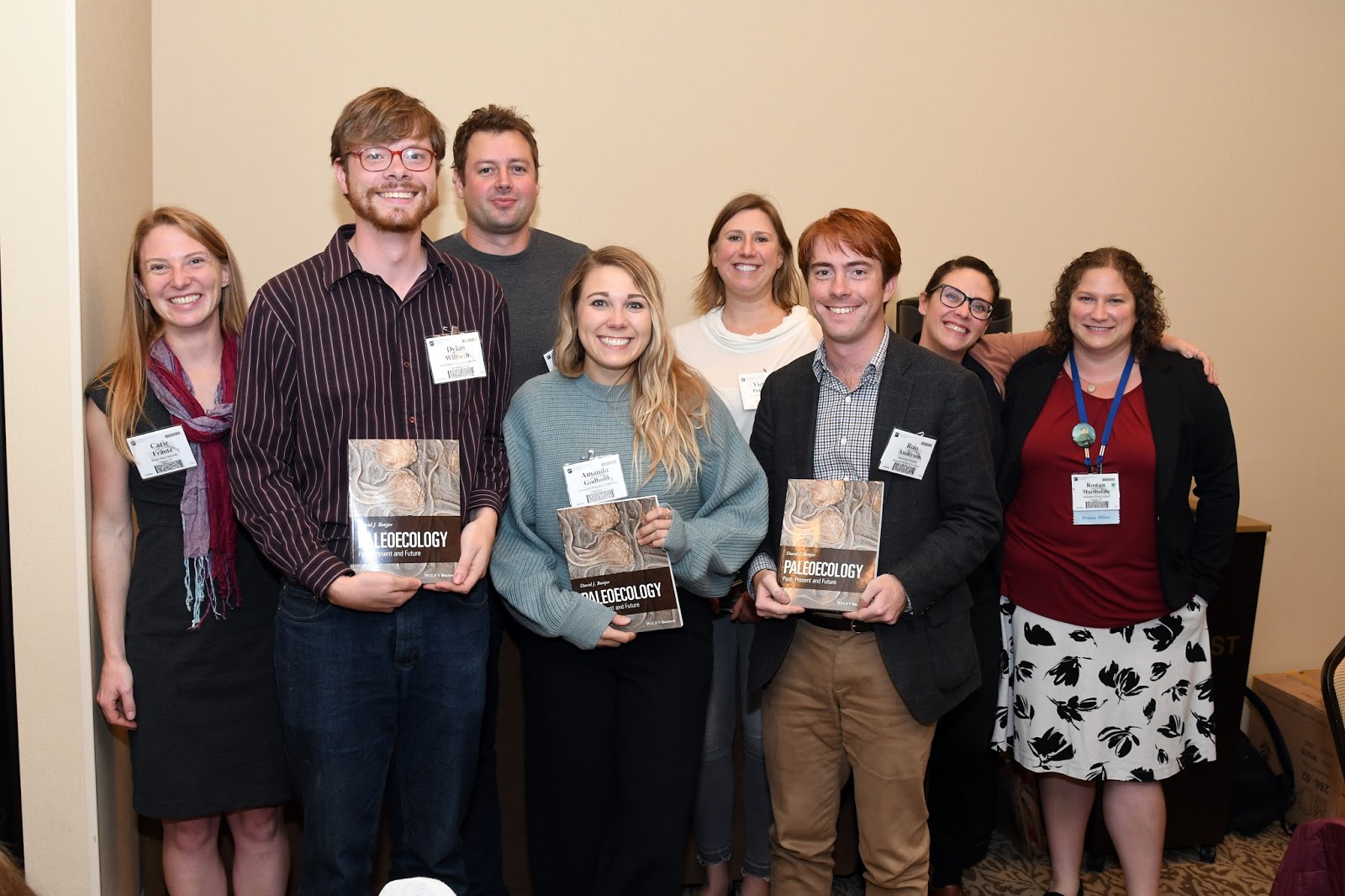
| (L to R): Carie Frantz, Simon Darroch, Vicky Petryshyn, Lydia Tackett |
This year's Post-Tenure Award Recipient: Susannah Porter (UC Santa Barbara)
| (L to R): Carie Frantz, Simon Darroch, Susannah Porter, Vicky Petryshyn, Lydia Tackett, Rowan Martindale |
| (L to R): Carie Frantz, Simon Darroch, Susannah Porter, Vicky Petryshyn, Lydia Tackett, Rowan Martindale |
This year's Pre-Tenure Award Recipient: Chris Reinhard (Georgia Tech)
| (L to R): Carie Frantz, Simon Darroch, Chris Reinhard, Vicky Petryshyn, Lydia Tackett, Rowan Martindale |
Monday, October 23, 2017
GSA Geobiology & Geomicrobiology Lunch at GSA 2017
Monday, 23 October 2017
12:00 PM - 01:15 PM
Sheraton Seattle Hotel - Issaquah
Friday, May 26, 2017
2017 Division Awards for outstanding research
Pre-Tenure Award Recipient: Chris Reinhard (Georgia Tech)
Chris studied ecology and evolutionary biology as an undergraduate at the University of Kansas and pursued graduate research in Earth Sciences at the University of California, Riverside. He is currently Assistant Professor at Georgia Institute of Technology, with research interests that revolve around characterizing the chemical evolution of Earth's ocean-atmosphere system, how this evolution has been shaped by major biotic and ecological innovations, and the ways in which this history can be used as a proxy for characterizing remotely detectable biosignatures.
Post-Tenure Award Recipient: Susannah Porter (UC Santa Barbara)
Susannah received her bachelor's degree in Mathematics from Yale University in 1995 and her Ph.D. in Biology at Harvard University in 2002. After completing a one-year NASA Astrobiology Post-Doctoral Fellowship at UCLA, she moved to the University of California at Santa Barbara, where she is Associate Professor and Vice Chair in the Department of Earth Science. She studies the early fossil record of animals and their protistan relatives and has worked on problems relating to the evolution of skeletal biomineralization, the influence of snowball Earth glaciations on the biosphere, the early evolution of eukaryotes, and the Cambrian diversification of animals. She lives in Carpinteria, California, with her husband, Jamie, and her two sons, Willie and Sam.
Distinguished Career Award Recipient: Marilyn Fogel (UC Riverside)
Marilyn received her B.S. degree in Biology form Pennsylvania State University and her Ph.D. in Botany (Marine Sciences) from the University of Texas at Austin. She spent the majority of her career as a Staff Member at the Carnegie Institution of Washington’s Geophysical Laboratory (1977-2012). In 2013, Marilyn started her career as a Professor at the University of California, first in Merced, and currently the Wilbur W. Mayhew Endowed Professor of Geoecology at the University of California, Riverside as well as the Director of the EDGE Institute. Marilyn's research concentrates on understanding the flow of elements through modern biogeochemical cycles using stable isotope compositions of organic and inorganic matter as tracers. She uses this knowledge of elemental cycling in modern ecosystems, to understanding how biogeochemical cycles functioned over Earth's history. Her work extends to the fields of paleontology and astrobiology.