Showing posts with label Awards. Show all posts

Monday, June 13, 2022

2022 Division Awards for Outstanding Geobiologists

Every year the GBGM executive committee selects exceptional scholars to receive awards for their accomplishments in research, education/mentoring, and service in geobiology. This year we had an exceptional list of nominees so thanks to all those who nominated someone!


We are pleased to announce that the 2022 awards go to Lidya Tarhan (pre-tenure), Cara Santelli (post-tenure), and John Valley (distinguished career). Please check out their brief biographies below and explore their websites for further details about their research.

Pre-Tenure Award Recipient: Lidya Tarhan (Yale University)


Dr. Lidya Tarhan is an Assistant Professor in the Department of Earth and Planetary Sciences at Yale University and an Assistant Curator of Invertebrate Paleontology at the Yale Peabody Museum. Her research focuses on using the sedimentary record to reconstruct the co-evolution of ancient life and environments during critical intervals of Earth’s history. She also investigates the processes responsible for fossilization and how preservational biases modify stratigraphic and geobiological archives. She combines field-based paleontological and sedimentological investigations with a geochemical, petrographic and modeling toolkit. Her recent work has centered on reconstructing the emergence of early animals as ecosystem engineers. In addition to her geologic investigations, she also studies the environmental factors shaping animal-sediment interactions in modern marine settings.


Post-Tenure Award Recipient: Cara Santelli (University of Minnesota) 


Dr. Cara Santelli is an Associate Professor in the Department of Earth and Environmental Sciences and the BioTechnology Institute at the University of Minnesota.  Cara is a geomicrobiologist who examines the impact of microbial activity on wide-ranging geological and environmental processes.  In addition to answering key questions on the mechanisms, metabolic pathways, and geochemical impact of mineral-metal-microbe interactions, her research seeks to inform and improve strategies for remediating pollutants to improve the health of water and soil environments. Her work also seeks to advance environmental justice through community based participatory research that prioritizes and addresses the voices of communities.


Distinguished Career Award Recipient: John Valley (University of Wisconsin-Madison)


John Valley is the Emeritus Van Hise Professor of Geochemistry at the University of Wisconsin-Madison, where he has taught for 36 years. Valley is interested by all kinds of rocks (igneous, metamorphic, and sedimentary) of all ages (Hadean to Recent). He has worked to improve microanalysis techniques of stable isotope ratios by laser and ion beam, and founded the WiscSIMS Lab at UW-Madison. His current projects investigate zircons and their inclusions to understand evolution of the crust and growth of continents. He has collaborated in geobiology research employing in situ analysis of O and C isotopes to evaluate vital effects vs. diagenesis, examine seasonality and paleoclimatology, determine migration history and paleodiet, and test biogenicity. This has included samples ranging from modern foraminifera, mollusks, otoliths, and  teeth to Earth’s oldest microfossils. Its been a lot of fun.


Please join us in congratulating these exceptional scientists at the 2022 GSA Connect Meeting in Denver; the awardees will be giving invited talks in our "New Voices in Geobiology" and "New Advances in Geobiology" sessions! Awards will be presented at the Geobiology Division Award Presentation (a.k.a. the GBGM Lunch).

Monday, July 26, 2021

2021 Division Awards for outstanding geobiologists

Every year the GBGM executive committee selects exceptional scholars to receive awards for their accomplishments in research, education/mentoring, and service in geobiology. This year we had an exceptional list of nominees so thanks to all those who nominated someone!

We are pleased to announce that the 2021 awards go to Kim Lau (pre-tenure), Phoebe Cohen (post-tenure), and Frank Corsetti (distinguished career). Please check out their brief biographies below and explore their websites for further details about their research.

Pre-Tenure Award Recipient: Kimberly Lau (Pennsylvania State University)


Dr. Kim Lau is an Assistant Professor in the Department of Geosciences at the Pennsylvania State University. Her research focuses on reconstructing biogeochemical changes in Earth’s past and specifically the causes and consequences of redox changes in ancient oceans using a combination of lab, modeling, and field methods. She is interested in major perturbations throughout Earth history and how these events are recorded geochemically in the sedimentary record. Her approach includes better understanding the sedimentary geochemical and isotopic proxies that geobiologists can employ to constrain past environmental change.


Post-Tenure Award Recipient: Phoebe Cohen (Williams College)


Dr. Phoebe Cohen is an Associate Professor in Geosciences at Williams College. Phoebe is a paleontologist who uses a wide array of microscopic, microchemical, and geochemical techniques, in combination with field-based stratigraphy and sedimentology, to reconstruct ancient organisms and ecosystems. Her current work focuses on the evolution of eukaryotes in the Proterozoic and the microfossil record of the end-Devonian mass extinction. She is also actively involved in justice, equity, diversity, and inclusion work in the geosciences. 


Distinguished Career Award Recipient: Frank A. Corsetti (University of Southern California)


Dr. Frank Corsetti is a Professor of Earth Sciences at the University of Southern California.  He studies the co-evolution of the Earth and its biosphere from a geobiologic/sedimentologic perspective, searching for traces of life in deep (and not so deep) time.  Key topics of study include the identification of biosignatures (in particular, those left behind by microbes), unraveling the diagenetic alteration of biosignatures, mass extinctions, the environmental setting for the emergence of animals, and the search for life beyond Earth.  Frank co-directed the International Geobiology Summer Course from 2010-2016.  He is a fellow of the Geological Society of America, recipient of the SEPM Dickinson Medal, the 2019 James B. Thompson Distinguished International Lecturer, and a recipient of the Mellon Mentorship award for mentoring graduate students.

Please join us in congratulating these exceptional scientists at the 2021 GSA (hopefully) in Portland; the awardees will be giving invited talks in our "New Voices in Geobiology" and "New Advances in Geobiology" sessions! The Geobiology Division Award Presentation (a.k.a. the GBGM Lunch) will be held virtually since this year's meeting will be offered in a hybrid format with limited in-person attendance.

Monday, November 23, 2020

Winners of the GSA GBGM Division Student Presentation Awards

Dear Geobiology and Geomicrobiology Division Members,

It is our pleasure to announce the winners of the GSA 2020 student presentation awards. We were all so impressed with the quality of presentations by our student members, especially given that for many of us, this was our first time attending and presenting at a virtual conference.

We would like to express our deepest gratitude to our members who judged this year's competition. Without your feedback and support, this endeavor would not be possible. There were many interesting talks and posters at this year's GSA Meeting, so thank you to everyone who participated.

To all of our students, congratulations on presenting at GSA this year. All of the excellent entries from you all truly made choosing winners difficult, but here are the students who will receive an award this year:

Best oral presentation winners:
  • Gwen Antell - "Thermal Niches of Planktonic Foraminifera are Static Throughout Glacial-Interglacial Climate Change"
  • Jack Shaw - "Methodological Advances in Inferring Ancient Food Webs"
Best poster presentation winners:
  • Yu Kai Tan - "Freshwater Mussels in North America: Museum Collections and Pre-Industrial Biogeography"
  • Amelia Lindsay Kaufman - "Two Novel Biomineralized Tubular Fossils from the Terminal Ediacaran, Central Iran"
Honorable mentions:
  • Erica Scarpitti (oral presentation) - "Association Between Tympanic Bulla Morphology and Locomotion in Rodents: Application to the Fossil Record"
  • Katie Maloney (oral presentation) - "Possible Multicellular Green Algae in Early Tonian Marine Environments"
  • Tian Gan (poster presentation) - "Paleo-Speleothems as Evidence for Widespread Karstification in the Aftermath of the Marinoan Deglaciation (635 Ma) in South China"
As with previous years, we will be handing out prizes to our award winners at GBGM awards luncheon next year at GSA 2021.

We'd like to thank all of the students who contacted us and put their names forward for consideration. It was a real privilege to see and hear about the work you've been doing, and we encourage you to enter again next year. Recognizing the excellent work of our members is the most important aspect of the GBGM division, so please stay in touch. It is wonderful to see the faces of the student population of GSA GBGM and there is a bright future ahead for this group!

Thank you,
Alison Cribb and the GSA Geobiology and Geomicrobiology Division


Tuesday, May 5, 2020

2020 Division Awards for outstanding geobiologists

Every year the GBGM executive committee selects exceptional scholars to receive awards for their accomplishments in research, education/mentoring, and service in geobiology. This year we had an exceptional list of nominees so thanks to all those who nominated someone!

We are pleased to announce that the 2020 awards go to Emmy Smith (pre-tenure), Greg Dick (post-tenure), and Kurt Konhauser and Will Berelson (distinguished career; we couldn't choose which one of these guys was the most deserving... so we just decided to have two awards this year) Please check out their brief biographies below and explore their websites for further details about their research.

Pre-Tenure Award Recipient: Emmy F. Smith (Johns Hopkins University)


Dr. Emmy Smith is an Assistant Professor in the Department of Earth and Planetary Sciences at Johns Hopkins University. She is a field geologist interested in the co-evolution of life, climate, oceans, and tectonics during the Neoproterozoic and Cambrian. Her approach integrates geologic mapping, regional stratigraphy, sedimentology, paleontology, stable isotope geochemistry, and geochronology to better understand mechanisms for environmental and evolutionary change during this unusual interval in Earth’s history.


Post-Tenure Award Recipient: Gregory Dick (University of Michigan)


Dr. Gregory (Greg) Dick is an Associate Professor in the Department of Earth and Environmental Sciences at the University of Michigan. He studies how microorganisms interact with each other and with geochemistry, mostly on the modern Earth but also to understand Earth’s geobiological history. Current research is focused on cyanobacteria; he aims to determine the controls on oxygen production in cyanobacterial mats and the environmental and biological factors that influence the production of toxins in harmful cyanobacterial blooms. He is particularly interested in merging approaches from molecular biology, microbiology, and geochemistry.

Distinguished Career Award Recipient: William M. Berelson (University of Southern California)


Dr. William (Will) M. Berelson is a Professor of Earth Sciences and Environmental Studies at the University of Southern California, where he has taught and conducted research for over 40 years. His early studies of bioturbation in St. Croix sands and North Carolina barrier island migration naturally(?) led him to a lifelong love of biogeochemistry. Many studies of benthic fluxes and elemental cycling in the ocean have been supported by his Rube Goldberg-like invention habit. His recent work is on calcium carbonate dissolution kinetics, CO2 sequestration, and the urban C cycle. In 2002, he and Kurt Hanselmann, with Agouron Foundation support, launched the Geobiology Summer course, which continues today cross-training graduate students and building a supportive and intellectual cohort. Degrees in geology at U. Rochester, Duke and USC have left him with great friendships and excellent basketball and football teams to cheer.

Distinguished Career Award Recipient: Kurt Konhauser (University of Alberta)


Dr. Kurt O. Konhauser is a Professor in the Department of Earth and Atmospheric Sciences at the University of Alberta. Kurt is the Editor-in-Chief of the journal Geobiology, author of Introduction to Geomicrobiology, founding member and 1st President of the Geobiology Society, and organizer for the 2017 and 2019 Geobiology Society Conferences in Banff. Kurt obtained his PhD from the University of Western Ontario before undertaking postdoctoral research at the University of Toronto and an academic appointment at the University of Leeds. Kurt moved to the University of Alberta in 2002 where he was the Canada Research Chair in Geomicrobiology. His research interests span a number of facets of geobiology and geomicrobiology including reconstructing the evolution of the biosphere across Earth’s history, modern analogue environments, and the surface reactivity of microbes and minerals. He is a Fellow of the Royal Society of Canada, the Geochemical Society, and the American Geophysical Union.

Please join us in congratulating these exceptional scientists at the GSA Geobiology Division Award Presentation (a.k.a. the GBGM Lunch) during the 2020 GSA in Montreal, Canada.

Friday, October 18, 2019

GSA 2019 Student Awards

Dear Geobiology and Geomicrobiology (GBGM) Division Members,

It is our pleasure to announce the winners of the 2019 student presentation awards. This year we had a record number of student participants and there were many interesting talks and posters at this year's GSA Meeting, so thank you to everyone who participated! As usual, we were all impressed with the quality and diversity of research conducted by our student members! Presentation feedback has been sent out.

The many excellent entries always make it difficult to choose winners, but here are the presentations that rose to the top.

Oral presentation winners:
Remy Rovelli - Using Paleoenm to predict patterns of survivorship in the hell creek formation ecosystems across the k/pg mass extinction
Samantha Ocon - Best practices for instagram as a geoscience education tool

Poster presentation winners:
Cathryn Sephus - Shedding light on phototrophic pigment evolution: reconstruction of ancestral rhodopsins
Martina Bennick - Determining the origin of intracameral deposits in the orthocerid genusarionoceras

Honorable mention:
Jasmina Wiemann - Metazoan biomolecule fossilization products record phylogeny, physiology, and biomineralization
Kathryn Mudica - Lead burden in long bones of north american river otters

As with previous years, we'll be handing out prizes at GBGM awards luncheon next year (GSA 2020). If you think you're not going to be able to make it to the meeting, please contact Rowan Martindale, and we'll find a way to get your award sent to you.

We'd like to thank all of the students who contacted us and put their names forward for consideration; it was a real privilege to see and hear about the work you've been doing, and we encourage you to enter again next year. Recognizing the excellent work of our members is the most important aspect of the GBGM division, so please stay in touch. It is wonderful to see the faces of the student population of GSA GBGM and there is a bright future ahead for this group!

We would especially  liketo express our deepest gratitude to our members who judged this year's competition. Without your feedback and support, this endeavor would not be possible. We are also very grateful to our student representative Amanda Godbold and Andrew Putt for coordinating everything.

All the best,
Rowan, Vicky, David, Trinity, Lydia, Simon
GSA GBGM Division Executive Committee

Amanda Godbold and Andrew Putt
GSA GBGM Division Student Representatives

Friday, September 6, 2019

2020 Simons Early Career Investigator in Marine Microbial Ecology and Evolution Awards

The Simons Foundation is now accepting applications for its Simons Early Career Investigator in Marine Microbial Ecology and Evolution Awards. The deadline for receipt of letters of intent (LOIs) is November 5, 2019, 5:00 PM Eastern Time.

The purpose of these awards is to help launch the careers of outstanding investigators in the field of marine microbial ecology and evolution who will advance our understanding through experiments, modeling or theory. Projects focusing on the microbiomes of animals or plants or on paleontological records will not be considered this year. Investigators with backgrounds in different fields are encouraged to apply.

Among other eligibility requirements, applicants must have held a tenure-track or equivalent independent position in a U.S. or Canadian institution for at least one year and no more than eight years.

Thursday, June 6, 2019

2019 Division Awards for outstanding geobiologists

Every year the GBGM executive committee selects exceptional scholars to receive awards for their accomplishments in research, education/mentoring, and service in geobiology. This year we had an exceptional list of nominees so thanks to all those who nominated someone!

We are pleased to announce that the 2019 awards go to Betsy Swanner (pre-tenure), Clara Chan  (post-tenure), and Russell Shapiro (distinguished career). Please check out their brief biographies below and explore their websites for further details about their research.

Pre-Tenure Award Recipient: Elizabeth (Betsy) Swanner (Iowa State University)


Betsy Swanner is an Assistant Professor in the Department of Geological and Atmospheric Sciences at Iowa State University. Dr. Swanner is interested in the impact of ferruginous conditions on life throughout Earth’s history. Her research seeks to determine the extent of ferruginous conditions through time and space, and how global biogeochemical cycles operate in iron-rich conditions, primarily those cycles mediated by microbes. She uses a wide variety of analytical tools coupled to experimental approaches and work in modern analogues.


Post-Tenure Award Recipient: Clara Chan (University of Delaware)


Dr. Clara Chan is an associate professor of Earth Sciences at the University of Delaware, specializing in geomicrobiology. She studies how microbes make minerals, addressing the molecular mechanisms of biomineralization, as well as the unique composition of biominerals. Her approaches integrate culturing, ‘omics, biochemistry, and field experiments in caves, deep sea vents, coastal environments, and streams. She loves to watch things grow, including her microbes, crystals, her garden, and her daughter.


Distinguished Career Award Recipient: Russell Shapiro (California State University, Chico)


Russell Shapiro is a Professor of Geology and (just recently) former department chair at California State University, Chico. Dr. Shapiro has studied Phanerozoic microbialites from the modern Bahamas all the way back to the Archaean; he then branched out to enigmatic iron formations and methane seep carbonates.  In particular, he is interested in how metamorphic processes affect the fidelity of geobiological signals.  He funded his college education as a tattoo artist both at Humboldt State and UC Santa Barbara. Dr.  Shapiro was a field instructor on the International Geobiology Course from 2010-2016, served on the editorial board for Astrobiology, and was the Biosignature Panel Chief for the Mars2020 mission.  In addition to his academic career, Shapiro also works as a consultant for paleontological resources.

While research is a passion, he is most proud of the service he has provided in various roles inside and outside of academia. If you see a problem that needs to be fixed, step up!

Please join us in congratulating these exceptional scientists at the GSA Geobiology Division Award Presentation (a.k.a. the GBGM Lunch) during the 2019 GSA in Phoenix.

Friday, March 15, 2019

2019 AWG Winifred Goldring Award & Undergraduate Excellence in Paleontology Award

AWG Winifred Goldring Award
The Association for Women Geoscientists is pleased to announce the Winifred Goldring Award competition. The award, which consists of a $2000 cash prize and membership in the Paleontological Society and AWG for tenure of the awardee’s schooling, will be presented to an outstanding female student pursuing a career in paleontology. The award is named for Winifred Goldring, a pioneering woman paleontologist, who became State Paleontologist of New York State in 1939 and the first female president of the Paleontological Society in 1949. This award was made possible by the generous donations of David Watkins and MaryAnne Holmes. 

All application materials must be received by April 15th. The winner will be notified in May and the award will be distributed in early summer.

QUALIFICATIONS

A. Applicants must be women pursuing education as a graduate student in the paleontological – and affiliated – sciences at a degree-granting institution. 

B. Applicant must be enrolled as a student during the period of the award.

C. Proof of student status in the form of transcripts (official or unofficial) must be provided. 

D. Successful applicants will exhibit exceptional motivation, professional potential, outreach, and long-term commitment to goals. 

E. Students may receive the Winifred Goldring Award only once during the tenure of their graduate school careers. 

F. No prior AWG or PS membership is required.

G. National or international students are allowed to apply, with the exception of sanctioned countries.

For more information about application requirements, visit the AWG Awards and Scholarships web page at www.awg.org/awards and click on the AWG Winifred Goldring Award.


Introducing the AWG Undergraduate Excellence in Paleontology Award
The Association for Women Geoscientists is pleased to announce the AWG Undergraduate Paleontology Award. The award, which consists of a $1000 cash prize and membership in the Paleontological Society and AWG for the tenure of the awardee’s schooling, will be presented to an outstanding female undergraduate student pursuing a career in paleontology. This award was made possible by the generous donations of David Watkins and Mary Anne Holmes. 

All application materials must be received by April 15. The winner will be notified in May and the award will be distributed in early summer.

QUALIFICATIONS

A. Applicants must be women pursuing education as an undergraduate student in the paleontological – and affiliated – sciences at a degree-granting institution. 

B. Applicant must be enrolled as a student during the period of the award.

C. Proof of student status in the form of transcripts (official or unofficial) must be provided. 

D. Successful applicants will exhibit exceptional motivation, professional potential, outreach, and long-term commitment to goals. 

E. Students may receive the Undergraduate Paleontology Award only once during the tenure of their undergraduate careers. 

F. No prior AWG or PS membership is required.

G. National or international students are allowed to apply, with the exception of sanctioned countries.

For more information about application requirements, visit the AWG Awards and Scholarships web page at www.awg.org/awards and click on the AWG Undergraduate Excellence in Paleontology Award.

Monday, November 19, 2018

2018 student presentation award winners

It is our pleasure to announce the winners of the 2018 student presentation awards. As usual, we were all impressed with the quality and diversity of research conducted by our student members! Presentation feedback will be sent out in the next week or so (hopefully while everything is still fresh in your memory).

We would like to express our deepest gratitude to our members who judged this year's competition. Without your feedback and support, this endeavour would not be possible. We are also very grateful to our student representative Amanda Godbold and Dylan Wilmeth for coordinating everything.
There were many interesting talks and posters at this year's GSA Meeting, so thank you to everyone who participated. The many excellent entries always make it difficult to choose winners, but here are the presentations that rose to the top.

Oral presentation winners:

Kathryn Mudica
 - Bioaccumulation Of Legacy Pollutants Using Lontra Canadensis (North American River Otter) As A Bioindicator

Erynn Johnson - 3D Printing Reveals Strengths And Weaknesses Of Prey Shape During The Mesozoic Marine Revolution


Poster presentation winners:
Broc Kokesh - Phenotypic Trajectory Analysis Reveals Temporal Divergence Of Shell Shape In Bivalves From Adjacent Marine Lakes

Maggie Stephenson - From Palm Savannahs To Hardwood Hammocks And Back: Palynology Of The Paleocene-Eocene Manawianui Drive Section, Bastrop County, TX


Honourable Mention:
Alison Cribb - Ecosystem engineering in the Ediacaran Nama Group, Namibia as a test for biological driver extinction of the Ediacara biota


As with previous years, we'll be handing out prizes at GBGM awards luncheon next year (GSA 2019). 

We'd like to thank all of the students who contacted us and put their names forward for consideration; it was a real privilege to see and hear about the work you've been doing, and we encourage you to enter again next year. Recognizing the excellent work of our members is the most important aspect of the GBGM division, so please stay in touch. It is wonderful to see the faces of the student population of GSA GBGM and there is a bright future ahead for this group!

All the best,

Rowan, Vicky, David, Trinity, Lydia, Simon

GSA GBGM Division Executive Committee

Friday, July 13, 2018

2018 Division Awards for outstanding research

Every year the GBGM executive committee selects exceptional scholars to receive awards for their accomplishments in research, education/mentoring, and service in geobiology. This year we had an exceptional list of nominees so thanks to all those who nominated someone!

We are pleased to announce that the 2018 awards go to Paula Welander and Jim Schiffbauer (pre-tenure), Beth Orcutt (post-tenure), and Andy Knoll (distinguished career). Please checkout their brief biographies below.

Pre-Tenure Award Recipient: Paula Welander (Stanford University)


Paula Welander is a microbiologist with interests in understanding the biosynthesis and physiological function of “molecular fossils” or lipid biomarkers in extant microbes. Paula received her undergraduate degree in kinesiology from Occidental College in Los Angeles. She obtained her PhD in microbiology at the University of Illinois at Urbana-Champaign where she studied methanogenesis with Prof. Bill Metcalf.  Paula then pursued postdoctoral studies on the biosynthesis of hopanoids, lipid produced by bacteria that also function as geological biomarkers, at MIT with Prof. Dianne Newman and Prof. Roger Summons. She joined the Stanford faculty in 2013 where she has continued her molecular work on lipid biomarkers in extant bacteria and archaea.

Pre-Tenure Award Recipient: James Schiffbauer (University of Missouri)


Dr. Schiffbauer is an Assistant Professor in the Department of Geological Sciences and Director of the X-ray Microanalysis Core at the University of Missouri. Schiffbauer’s academic background spans both biology and geology, and his research interests center on how accurately the history of life can be interpreted through the fossil record. Specifically targeting the taphonomy of complex multicellular fossils from the dawn of animal life at the Ediacaran–Cambrian transition, Schiffbauer uses advanced microscopy methods, including analytical scanning electron microscopy and tomographic x-ray microscopy, to help resolve which features of fossils represent true biological signal as opposed to those that are instead preservational noise.


Post-Tenure Award Recipient: Beth Orcutt (Bigelow Laboratory for Ocean Sciences)


Dr. Beth Orcutt is a Senior Research Scientist at the Bigelow Laboratory for Ocean Sciences in East Boothbay, Maine. Orcutt’s research focuses on understanding microscopic life at and below the seafloor, to resolve the importance of microbes in global chemical cycling while also revealing how life can survive in extremes for future astrobiology investigations. Having spent over 560 days at sea on 35 different field missions, Orcutt is an expert in ocean exploration technology.


Distinguished Career Award Recipient: Andrew Knoll (Harvard University)


Andrew Knoll is the Fisher Professor of Natural History at Harvard University, where he has taught for the past 36 years.  Knoll has longstanding interests in life and environments on the Archean and Proterozoic Earth, but he has also worried about Phanerozoic plant, animal, and phytoplankton evolution.  Much of Knoll’s paleontological and biogeochemical research derives from careful fieldwork, including successions in the Arctic, Siberia, China, Australia, and – virtually, at least – Mars.

Please join us in congratulating these four exceptional scientists at the GSA Geobiology Division Award Presentation during the 2018 GSA in Indiana.

Wednesday, April 4, 2018

2018 Division nomination deadline extended

A huge thanks to all of you who have sent us nominations for the 2018 GBGM division awards - they're excellent, and much appreciated! Although we now have nominees in each ctaegory (pre-tenure, post-tenure, and distinguished career), we still feel that we would like a larger pool to choose from in a couple of the categories (because we know that there are more amazing people out there!).

As a result, we are extending our nominations deadline to April 15th.

If you know of someone who you feel is deserving, please nominate them. Please use this nomination form to identify exceptional researchers who you think should be recognized, along with a justification (max. 500 words). Final nominees will be selected by the GBGM committee from amongst this pool, and awarded based the nominee’s complete portfolio (i.e., research, mentoring, service, and leadership). 

You can find all the nomination information (plus past awardees) here: http://gsageobiology.blogspot.com/2018/03/help-us-choose-2018-awardees.html

Monday, March 19, 2018

Help us choose the 2018 Awardees

Dear GSA GBGM,

Every year the GSA Geobiology and Geomicrobiology division selects three exceptional researchers to receive pre-tenure, post-tenure, and distinguished career awards (for details on past awards, see the GBGM website, or see below). This year (2018), the division has decided that our members should play a more prominent role in choosing exceptional scientists for these awards. We are requesting nominations from our GSA GBGM members in order to create a more diverse and inclusive nominee pool, both in terms of academic fields, and demographics.

Please use this nomination form to identify exceptional researchers who you think should be recognized, along with a justification (max. 500 words). Final nominees will be selected by the GBGM committee from amongst this pool, and awarded based the nominee’s complete portfolio (i.e., research, mentoring, service, and leadership). Please submit your nominations by April 2nd, 2018.

We're grateful for your participation in this process - we know that your time is valuable, but this is one of the most important things the division does, and we think the community (not just us) should have a stronger say.

All the best, and we hope to being seeing your nominations soon!
Simon, Rowan, Vicky, Lydia, and Carie

Previous Award Winners:


Pre Tenure Award

2017: Christopher Reinhard
2016: Erik Sperling
2015: Arpita Bose
2014: Rob Sansom
2013: David Johnston
2012: Alexis Templeton
2011: David Fike

Post Tenure Award

2017: Susannah Porter
2016: Tanja Bosak
2015: Tim Lyons
2014: Sara Pruss
2013: Kurt Konhauser
2012: Barbara Sherwood-Lollar
2011: James Hagadorn

Distinguished Career Award

2017: Marilyn Fogel
2016: Dawn Sumner
2015: Elizabeth and Rudy Raff
2014: Shuhai Xiao
2013: Stan Awramik
2012: Jack Farmer
2011: Derek Briggs

Awards before career-stage differentiation

2010: John Grotzinger, Rich Lane, Nora Noffke;
2009: Anna Louise Reysenbach, Mary Droser, and Ken Eriksson

Friday, December 1, 2017

Awards for Best Student Presentations at the 2017 GSA

Hey everyone! We are pleased to announce the student presentation award winners from the 2017 GSA meeting.


For the best talk:

Jeffrey Osterhout: Stable Isotope Geochemistry Of A Late Archean Microbial Ecosystem: Diversity In The Pre-GOE Oceans

Jack Shaw: Planktonic Foraminiferal Bleaching During Early Eocene Hyperthermal Events


Honorable Mentions: 

Erynn Johnson: Shells And Marine Revolutions: Experimental Tests Of Theoretical Shell Shapes

Daniel Killam: Pollution, Growth Rates, And Conservation Of Red Sea Giant Clams Using Isotope Sclerochronology


For the best poster:

Camille Dwyer: δ18O Schlerochronology Of Late Cretaceous Bivalves And Preservation Of Seasonality Irrespective Of Alteration

Jana Meixnerova: Did Volcanism Cause The Whiff Of Oxygen 2.5 Billion Years Ago?


CONGRATULATIONS ALL!

Winners will be awarded a prize at the 2018 GSA meeting.

Monday, November 6, 2017

Thanks for a great GSA 2017

Hi Everyone,

The GSA Geobiology & Geomicrobiology Division Executive Committee would like to say a hearty "THANK YOU" for making this past GSA annual meeting in Seattle such a success. The number of GBGM talks skyrocketed this year and (as is often the case), it was standing room only for the awards luncheon.

Below are some photos of the awards lunch.


(Most of) the GBGM Executive Committee
(L to R): Carie Frantz, Simon Darroch, Vicky Petryshyn, Lydia Tackett

This year's Post-Tenure Award Recipient: Susannah Porter (UC Santa Barbara)

(L to R): Carie Frantz, Simon Darroch, Susannah Porter, Vicky Petryshyn, Lydia Tackett, Rowan Martindale

This year's Pre-Tenure Award Recipient: Chris Reinhard (Georgia Tech)
(L to R): Carie Frantz, Simon Darroch, Chris Reinhard, Vicky Petryshyn, Lydia Tackett, Rowan Martindale
 The winners of the best student talk and poster presentations from the 2016 GSA annual meeting
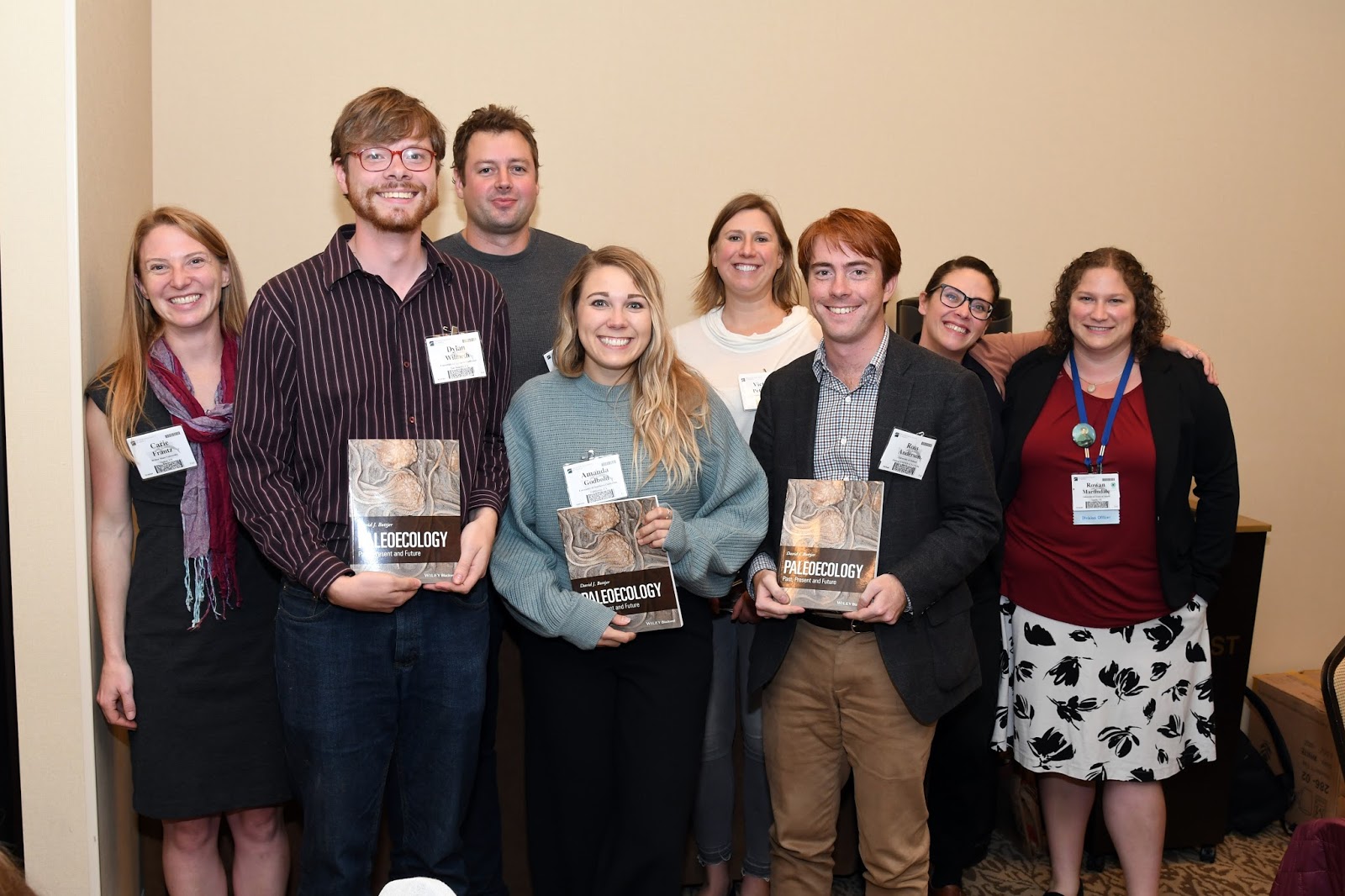
(Back row, L to R): Carie Frantz, Simon Darroch, Vicky Petryshyn, Lydia Tackett, Rowan Martindale. (Front row award winners, L to R): Dylan Wilmeth, Amanda Godbold, Ross Anderson (Natalia Bykova not present)
    
 And a few more shots of the room....


SEE YOU NEXT YEAR!

Monday, October 23, 2017

GSA Geobiology & Geomicrobiology Lunch at GSA 2017

Today is the day! Come by for the GSA GBGM annual luncheon and division awards at GSA 2017 in Seattle. No reservations needed, lunch is free for all Geobiology enthusiasts!

Monday, 23 October 2017
12:00 PM - 01:15 PM
Sheraton Seattle Hotel - Issaquah